
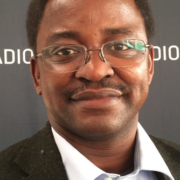
Illia Djadi, who works with Open Doors to defend religious freedom in Africa, was in French-speaking Switzerland this week to prepare for the third meeting of journalists and radio hosts, which will be held in Lomé from November 23 to 27 under the patronage of Radio Réveil in Bevaix (CH). This journalist, formerly with the BBC, reveals here some key points of his presentation: the importance of promoting peaceful coexistence between ethnic and religious communities. Interview.
An interview with Serge Carrel, published on FREE's website
Illia Djadi, at Lomé 3, you will advocate for the importance of developing programs in Francophone African evangelical radio stations that address peaceful coexistence. Why?
This is a timely topic that is crucial today, given the situation in all countries of the sub-region. Whether in Niger, Mali, Burkina Faso, or elsewhere, peaceful coexistence is currently under threat. This is particularly due to the emergence of jihadist movements... Yes. Jihadist movements are active throughout this part of the southern Sahara. They threaten the very existence of countries like Mali, Burkina Faso, and Niger. These armed groups attempt to divide communities along ethnic or religious lines. For hundreds of years, these religious communities have learned to live together, despite localized conflicts.
How can churches act to counter this dynamic of Islamization that we are witnessing in Francophone Africa?
In Francophone Africa, churches and their affiliated radio stations are major players in the social landscape. Churches participate in the education of children and young people; they are involved in social development and construction projects, as well as in health centers. Today, we realize that the existence of these churches is threatened because Christians themselves are under threat. Hence, churches have a responsibility to take a stand as social actors to ensure that action is taken.
Specifically, what role can evangelical radio stations play? Given the importance of radio as a medium in Africa, producing programs that raise awareness about peaceful coexistence and social cohesion is fundamental. Do you have examples where radio has played an important role in promoting a culture of tolerance between communities?
In Niger, my home country, following the Charlie Hebdo events in Paris in January 2015, about a hundred churches and buildings belonging to Christians were ransacked and destroyed. Following this event, there was a widespread awakening of consciousness, to the extent that the main leaders of religious communities, including Protestants, Catholics, and Muslims, could be seen together on the same radio or television program. Simply by coming together, they sent a strong symbolic message to the entire population. They were able to say: 'We are united. What happened was an unfortunate and isolated incident. It is not representative of Islam. The majority of Muslims do not identify with these atrocities. With one voice, we reject and condemn what happened!'
Are there other examples where radio helped to de-escalate a situation?
In Burkina Faso, thanks to radio stations that broadcast programs in all local languages, it is possible to send messages to different communities, whether Mossi or Fulani, to draw their attention to the danger threatening this country, known for its culture of tolerance. Practically, a Christian radio station can occasionally invite an imam into its studio. This is already a strong symbol of accepting others and their differences. Theological teaching is also needed so that local Christians understand that persecution is an integral part of Christian life…
But isn't that already a retreat in the face of the emergence of these violent movements?
No, it's primarily about raising awareness to react appropriately in such a context. Persecution can take several forms. Today, we realize that it arises from Islamic fundamentalism and attacks perpetrated by extremist groups. In such a context, an ostrich policy, which involves burying one's head in the sand, is not enough. We must offer a counter-narrative based on the love that Christ calls us to show to our neighbor, including our enemy. Such a counter-narrative can counteract the hate speech used by Islamists, because people are receptive to gestures of love, acts of love, and messages that promote tolerance. Therefore, programs need to be produced that, as highlighted by the Lomé 2 conference in 2019, develop a holistic approach, one that considers and responds to the realities and challenges facing society and churches today.