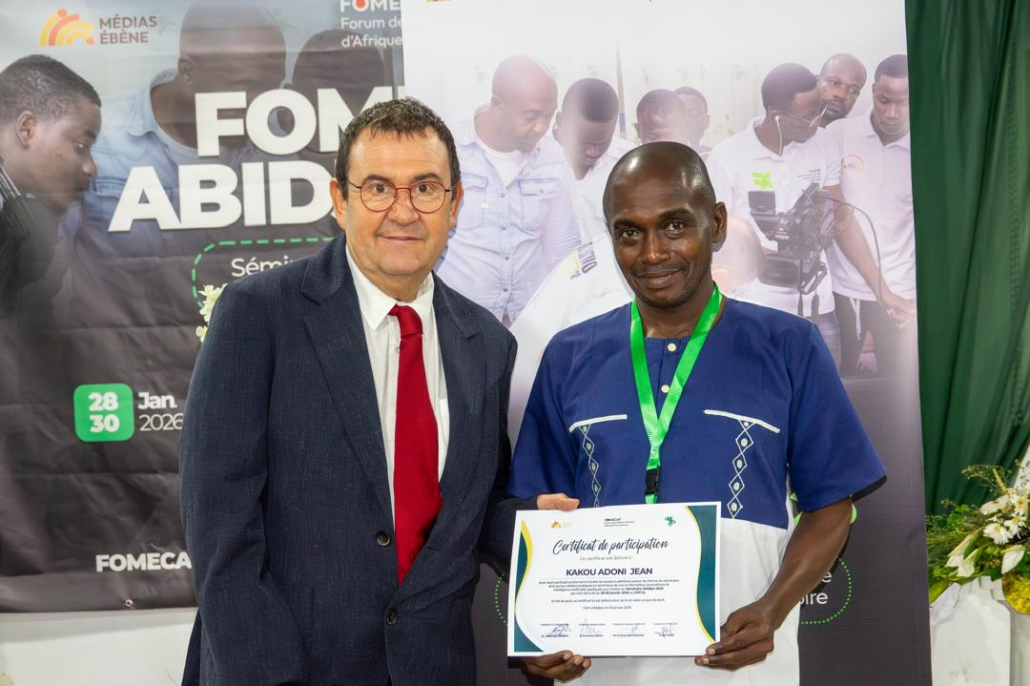
As the threat of violent extremism gradually shifts from the Sahel to the countries of the Gulf of Guinea, the response is not limited to the military sphere. It is also at the heart of newsrooms. From January 28 to 30, Médias Ébène and FOMECAF brought together 57 Ivorian media professionals at CEFCA (Abidjan) for an intensive seminar focused on social cohesion and resilience.

Fifteen years after the Libyan crisis, the situation in the Sahel is grim, but the landscape is changing. According to the Global Terrorism Index, the region now accounts for nearly half of all terrorism-related deaths worldwide. Even more alarming for coastal countries: the boundaries of insecurity are blurring. The northern parts of Côte d’Ivoire, Benin, Togo, and Ghana are facing increasingly frequent incursions.

It is against this backdrop of urgency that FOMECAF (Forum of Christian Media in Francophone Africa) and its technical partner, Médias Ébène, have chosen to take action—moving beyond grand statements to focus directly on training in the field.

Accurate information: the first line of defense against fear

For several days, 24 Christian media outlets from across Côte d’Ivoire—radio stations, television stations, editors-in-chief, and communications professionals—gathered alongside national and international experts. The goal? To move beyond merely observing the situation and to equip teams with the technical and editorial tools they need to counter radical rhetoric.

“In your newsrooms, the situation is truly urgent, and we must act as quickly as possible. Prevention is better than cure, and treatment is really very expensive, one speaker noted during the sessions.

Through hands-on workshops, Médias Ébène has shared its technical expertise: modern production tools, radio formats adapted for digital platforms, fact-checking techniques, and responsible coverage of sensitive topics. The goal is not to produce something spectacular but short-lived. The challenge is to broadcast, week after week, in local languages, well-researched programs capable of strengthening the social fabric in a sustainable way.

Solutions-Based Journalism in the Service of Peace

In the face of the crisis, the role of journalists is changing. It is no longer simply a matter of reporting on the tragedy, but of steering media coverage toward fostering social cohesion and peace. This seminar laid the groundwork for “solutions-oriented journalism” in Côte d’Ivoire, which is essential to prevent the media from becoming—even unintentionally—a platform for misinformation or hate speech.

The Rebirth of CEFCA: A Pan-African Center of Excellence

The choice of venue for this seminar was no accident. CEFCA (Evangelical Center for Training and Communication in Africa), a long-standing institution that has trained generations of prominent media figures—including journalists who went on to make their mark at the BBC or in Switzerland—is now rising from the ashes.

This seminar marks a crucial step toward restoring CEFKA to its original purpose: to serve as a hub of pan-African excellence and a breeding ground for talent where the next generation of media professionals from across the subregion is nurtured.

A stage victory

While the UN estimates that nearly 5 million people have been forcibly displaced in the region, the commitment of media professionals in Abidjan offers a message of hope. By kindling the flame of training, vigilance, and responsibility, Médias Ébène and FOMECAF remind us that words that unite are the most powerful weapon against those that divide.
“Sub-Saharan and Central Africa has become the new global epicenter of jihadism, where groups affiliated with al-Qaeda and the Islamic State are seeking to establish a Sahelian caliphate by encircling urban centers.” In a recent article, Illia Djadi, senior analyst at Open Doors in London, notes that “this security threat is accompanied by a deliberate social divide, targeting Christian minorities and transforming the region into one of the world’s most severe hotspots of religious persecution.” Beyond religious issues, and further afield in Central Africa, occupying forces such as the M23 are also terrorizing populations over territorial disputes. Amid this chaos, radio has emerged as a vital medium—a last bastion whose influence is so great that it has become a prime target for those seeking to silence any message of peace. We explore this reality through the accounts of five witnesses in Côte d’Ivoire, Burkina Faso, Mali, and the Democratic Republic of the Congo (DRC).

Ivory Coast 2002: Jean Seri, a Pioneer of Radio Resilience

On September 19, 2002, at 3 a.m., Abidjan was plunged into violence following an attempted coup. In today’s African context, marked by security crises and the rise of radicalism, Jean Seri’s experience serves as a harbinger. While major international broadcasters such as RFI, the BBC, and Africa Numéro 1 were silenced, Christian radio remained the sole beacon amid the turmoil.

The Courage of Faith at the Heart of the Struggle

Jean Seri, a SIM missionary and now Chairman of the Board of Directors of Fréquence Vie, lived right next to the studios. The studios were located at a strategic intersection, between the gendarmerie academy and the police academy. Faced with the chaos, he made a historic decision: to open the station at 5 a.m. to invite Ivorians to pray and to broadcast music to soothe their hearts. Alone at the microphone while gunfire rang out, he transformed the media outlet into a tool for spiritual resistance and peace.


This bold presence on the airwaves did not go unnoticed by the attacking forces. On the second day, a rebel called the station directly to demand that the broadcasts be stopped: “You must stop calling on people to kneel and pray… These prayers have prevented our mission from succeeding.” Despite the explicit threat that the radio station would be destroyed, Jean Seri responded with disarming calm, urging his caller to “be reconciled with God rather than kill his fellow man.”

A National Heritage That Is Rapidly Expanding

Today, this legacy of resilience has enabled the station to become the national radio station of the Evangelical Protestant Churches of Côte d’Ivoire. A true media institution, it broadcasts nationwide from Abidjan on 89.4 FM. Its signal now reaches five other key cities across the country: Abengourou, Bouaké, Man, and Yamoussoukro. For Jean Seri, Christian radio stations remain essential tools for preventing the rise of radicalism, as they carry a message of love and peace to places where people can no longer go.

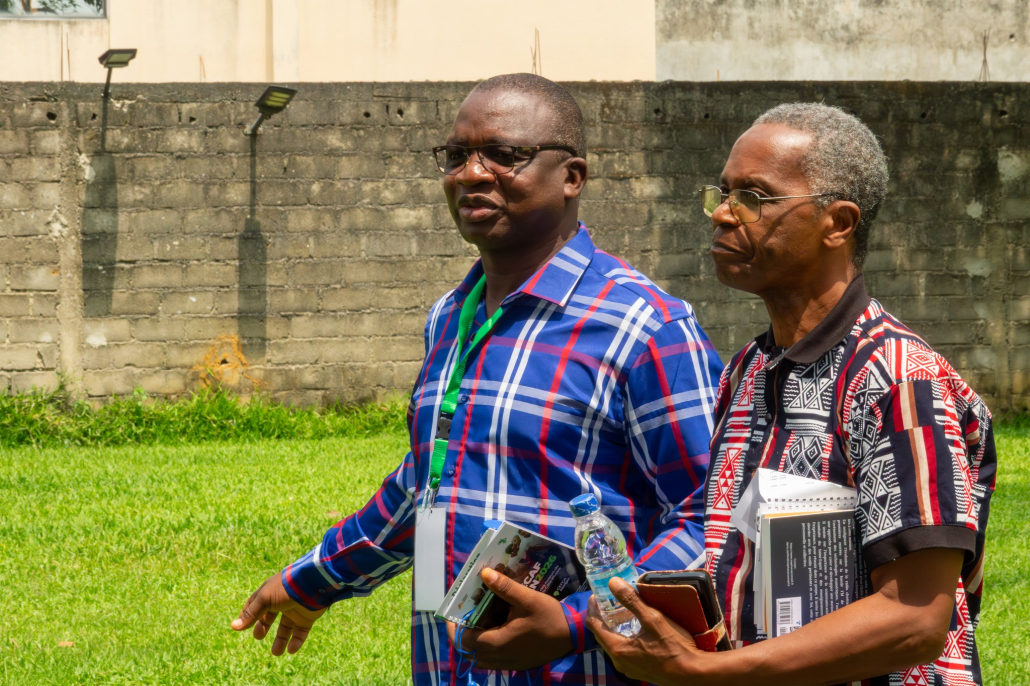
To be reconciled with God rather than kill one's fellow human being – Jean Seri, pictured here on the right, Abidjan 2026

The year 2026 is off to a strong start. The success of the recent seminar in Abidjan confirmed the vital role of faith-based media as a bulwark against radicalism. To sustain this momentum, your support is essential.

Our 2026 program is ambitious: in September, a seminar in Chad with Africa by Radio (AbR) will strengthen continental collaboration. We are planning a technical tour of some 40 radio stations, culminating in the “Lomé 6” seminar, which will bring together 100 stakeholders from 15 countries. On a day-to-day basis, Médias Ébène provides ongoing strategic support to the 200 media outlets in the FOMECAF network.

Carrying out these missions requires an operating budget of more than €100,000. This amount, which does not include our correspondent’s salary, is vital to continuing the legacy of Radio Réveil and Radios Ébène Développement—which began in Africa as early as 1960—in order to preserve decades of valuable work on the continent.

Emmanuel Ziehli, in favor of “comprehensive radio”

Emmanuel Ziehli, who has been serving for 16 years, advocates a holistic mission: “integral radio.” Here, the spiritual message is accompanied by a response to the practical needs of the affected communities. His employment in Switzerland is secured by the SMG in Winterthur, but his salary is not yet fully covered. Your direct support is therefore crucial to the mission.