Dans une région sous tension permanente, fragilisée par les violences et l’enclavement, deux stations de radio locales bravent l’insécurité et les pannes pour transmettre des messages de paix, de formation et de réconciliation
Porter la voix là où la peur isole
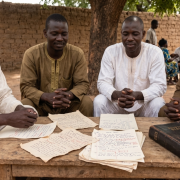
Dans l’Extrême-Nord du Cameroun, les incursions de Boko Haram ont semé la terreur, poussant des populations entières à la méfiance et restreignant les déplacements. C’est pour briser cet isolement que Radio Sawtu Ngendam (« La Voix de la Vie ») a vu le jour à Miskin (Maroua) sous la houlette de son directeur, Yaya Pitchémé.
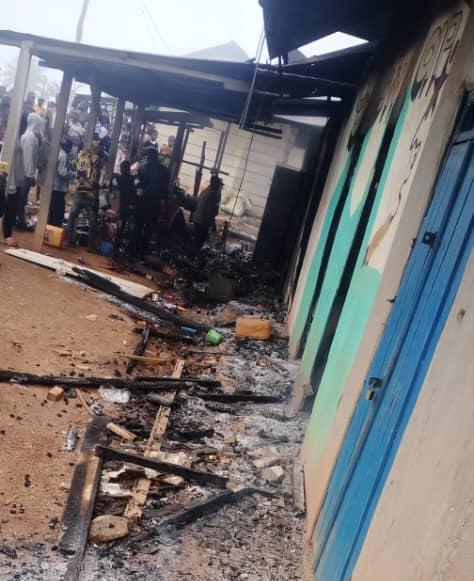
Face à l’adversité – la station a même subi un cambriolage dévastateur –, l’antenne poursuit sa mission. Elle informe, forme la jeunesse, enseigne l’agriculture et propose des débats interactifs plébiscités par des milliers d’auditeurs. Le lien tissé avec la population est si profond que des villages reculés, jusqu’à Koza, sollicitent l’équipe pour créer de nouvelles antennes locales et redonner courage aux habitants traumatisés par les attaques.
Un instrument de dialogue et de métamorphose
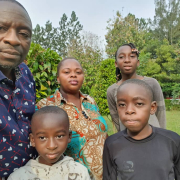
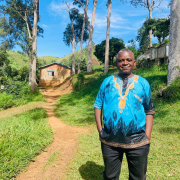
Plus au sud, à Bibémi, Inzoumba Noël dirige depuis 2012 Radio Bonne Semence. Conçue au départ pour atteindre des communautés avec lesquelles le dialogue direct semblait impossible, la radio s’est imposée comme un espace d’apaisement.
Grâce à des « clubs d’écoute » structurés dans les villages, chrétiens et non-chrétiens soutiennent activement la station. Les programmes ont permis de dépasser les fractures communautaires et de toucher les cœurs, à l’image du fils d’un adjoint au sous-préfet musulman, transformé au contact de l’antenne et devenu pasteur.
L’urgence vitale de l’énergie solaire
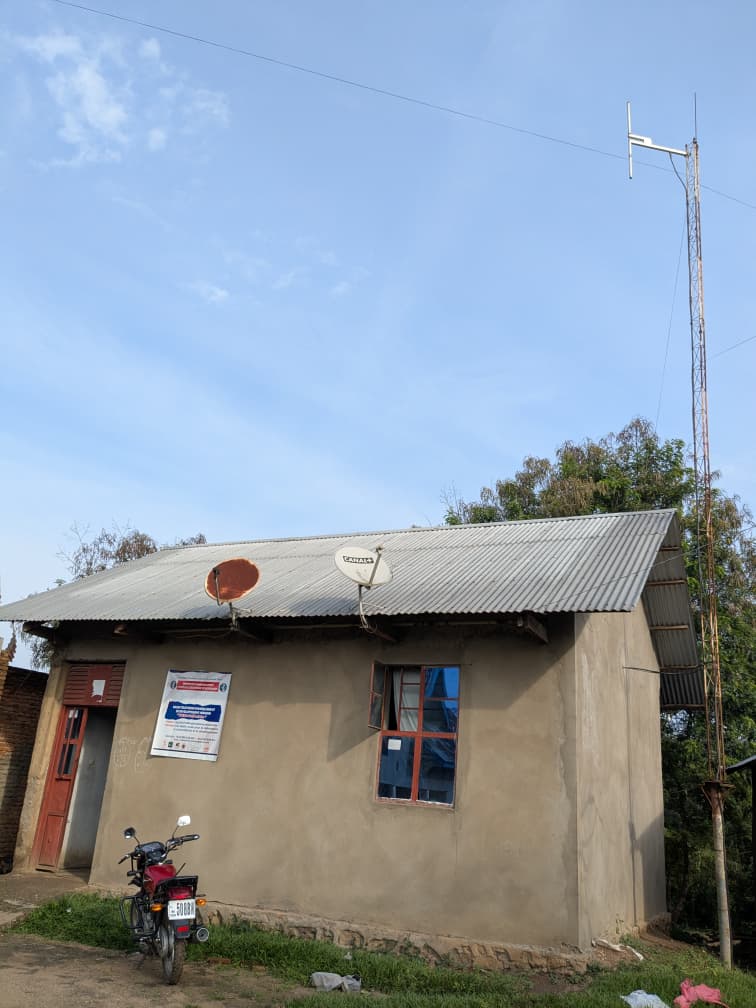
Ce ministère radiophonique reste entravé par une précarité majeure : les coupures d’électricité incessantes et les surtensions qui grillent émetteurs et régulateurs. Les auditeurs s’inquiètent dès que le signal se coupe. Pour ces sentinelles du Nord-Cameroun, l’installation de panneaux solaires fiables est l’ultime rempart pour maintenir la lumière sur les ondes.
https://mediasebene.org/wp-content/uploads/2026/09/1789156780436.png7681408Emmanuel Ziehlihttps://mediasebene.org/wp-content/uploads/2024/11/logo-medias-ebene-web-202411-300x138.pngEmmanuel Ziehli2026-09-09 08:15:562026-09-11 22:00:25Nord Cameroun : face à la terreur de Boko Haram, des radios locales sèment l’espérance
In the Rutshuru territory, the Evangelical Radio and Television Station for Harmonious Development (RTEDH) faces a unique challenge to its sovereignty. Since the arrival of M23 rebels in October 2022, the station has been operating in an area beyond the control of the Congolese government. Unlike the indiscriminate violence seen in Bukavu or Uvira, the M23’s entry into Rutshuru was more “peaceful,” though not without intense psychological and administrative pressure on the media.
The "Contract" of Coercion
The most significant incident during this occupation was the forced signing of a broadcasting agreement. Two weeks after cutting off their signal for security reasons, radio station officials were summoned by the M23. Under the pretext of “ensuring security,” the rebels demanded that programming resume, even going so far as to offer refreshments to celebrate this new agreement. They even requested airtime to promote their political and development agenda, placing religious radio stations in the difficult position of being forced to collaborate.
Exile to Continue Serving
For Kipesse Johnson, the price of resistance was exile. Alerted by friends that he was being sought by the new de facto authorities because of his influence, he was forced to flee toUganda with his family. Today, he embodies a new form of resilience: remote leadership. Thanks to digital tools, he continues to run the radio station and organize meetings with his team back home.
Evangelical Radio and Television for Harmonious Development
A Glimmer of Hope Amid the Occupation
Despite this precarious situation, the radio station has managed to extend its broadcast hours and now airs from 4 a.m. to 10 p.m. While the current situation appears calm on the surface, the hope for the rebels’ withdrawal and the return of the displaced remains the top priority. Kipesse Johnson, though struggling to make ends meet in Uganda, refuses to give in to fear: “A prudent man sees danger from afar.” His daily struggle to keep the RTEDH signal on the air attests to the vital importance of the radio station as the last social and spiritual link for a population living under occupation.
https://mediasebene.org/wp-content/uploads/2026/07/Kipese-Johnson-family.jpeg684912Emmanuel Ziehlihttps://mediasebene.org/wp-content/uploads/2024/11/logo-medias-ebene-web-202411-300x138.pngEmmanuel ZiehliJuly 15, 2026, 9:10:46 AMJuly 15, 2026, 9:13:09 AM“Shock Waves” Series: North Kivu (DRC)—Rutshuru in the Shadow of the M23: Leading the Faith from Afar
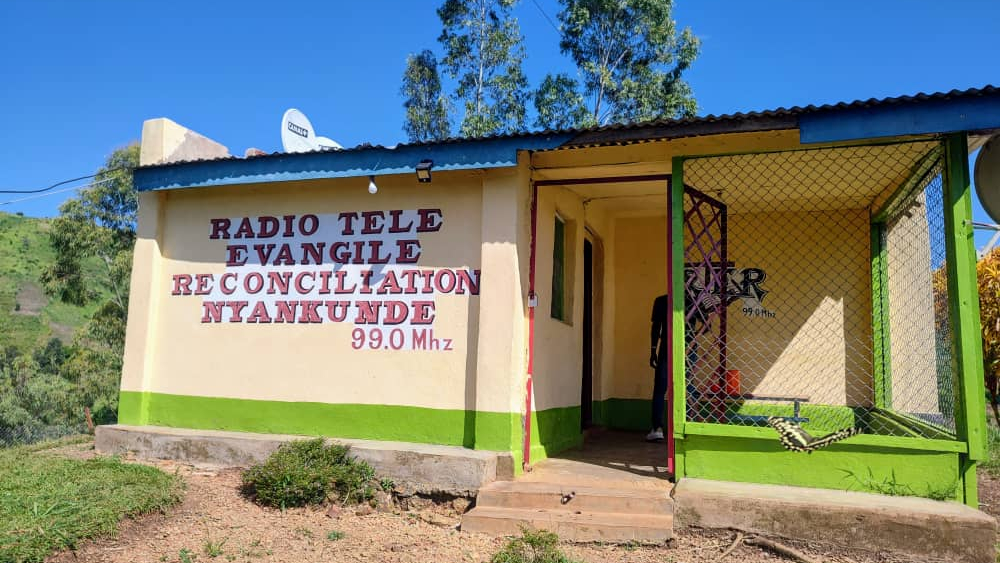
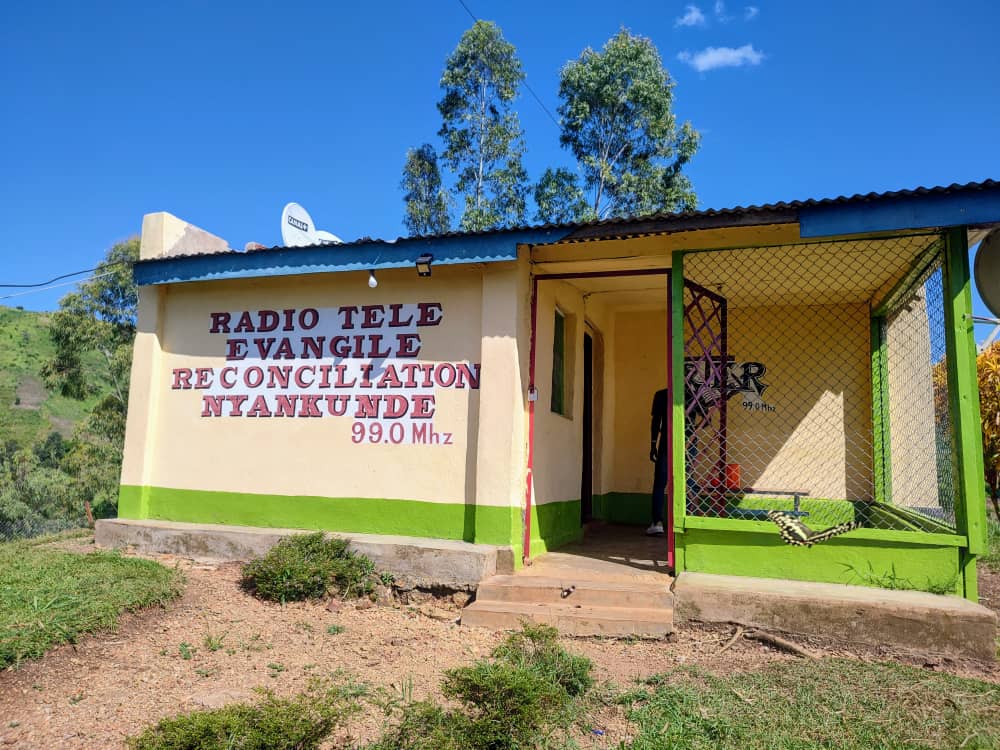
In Ituri Province, in the northeast of the Democratic Republic of the Congo, the small village of Nyankunde is home to a station whose name sounds like a challenge: Radio-Télévision Évangile Réconciliation. Perched on a mountain to better broadcast its signal, the radio station overlooks exceptionally rich soil, teeming with gold, coltan, and uranium. These resources attract the interest of multinational corporations and foreign powers such as China, the United States, and Russia—through the Wagner Group—transforming the region into a constant focus of international covetousness.
The ADF: The Tactics of Terror and Silence
The main adversary facing the local populations is the ADF (Allied Democratic Forces), a radical Islamist group seeking to impose Sharia law on Christian communities in the eastern part of the country. For these jihadists, targeting Christian institutions such as churches, schools, and media outlets is a deliberate tactical choice. News of the attack spreads more quickly by word of mouth, which amplifies their propaganda and forces people to flee, thus leaving the ground open for their training camps.
ADF Violence in Ituri, Almost Daily
Between Direct Threats and Psychological Pressure
ADF members do not merely observe the radio station from a distance; they listen to it closely to monitor the messages broadcast and the intentions of the Christian community. Jean-Luc Simbilyabo reports direct interventions and constant pressure, including intimidating calls from Ugandan phone numbers in which the kidnappers promise to forcibly convert Christians to Islam. At the same time, the imam of a nearby mosque has requested airtime, a move perceived by the radio station’s committee as a form of pressure coordinated with the intensity of the massacres in the region.
The Indescribable Price of Blood and Loyalty
Jean-Luc’s courage came at the cost of indescribable personal tragedies, as he survived three major attacks that struck his loved ones. During a massacre in Komanda, members of his in-laws’ family were burned to death in their vehicle following a jihadist raid on a Sunday. Later, during a direct raid on his home explicitly aimed at finding him, the attackers unleashed their violence on his eldest daughter, who was brutally raped in retaliation for her father’s activism while he was away.
A voice of comfort beneath a “veil of fear”
Today, Nyakunde lives under a cloud of constant fear, and blood pressure among the population is at an all-time high. Yet the radio station remains active and continues to mobilize local pastors to broadcast messages of comfort in various regional dialects. To ensure the continuity of this vision despite the threats, Jean-Luc’s son is currently completing a master’s degree in media studies in Uganda so that he can soon take up the torch. Jean-Luc remains steadfast in his mission, reminding everyone that even though they walk through the valley of the shadow of death, they will fear no evil.
“No matter how dark the path ahead may be or how difficult the trials we face, let us remain steadfast and unshaken in our mission. Remember these words from the Psalm: even though we walk through the valley of the shadow of death, we will fear no evil. Our determination is our greatest strength.” — Jean-Luc Simbilyabo
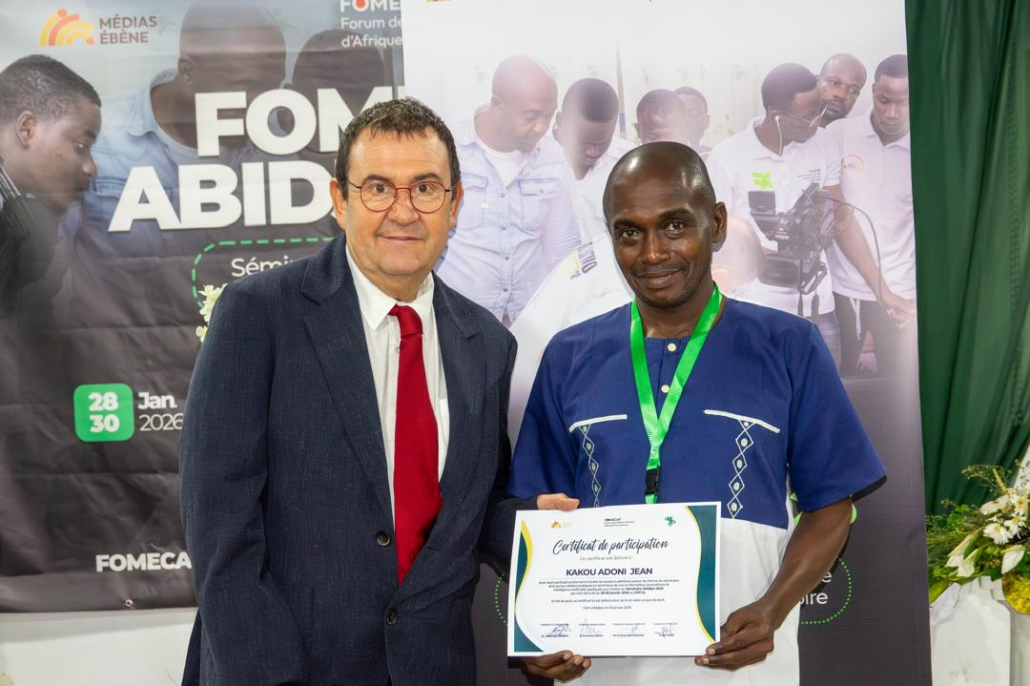
As the threat of violent extremism gradually shifts from the Sahel to the countries of the Gulf of Guinea, the response is not limited to the military sphere. It is also at the heart of newsrooms. From January 28 to 30, Médias Ébène and FOMECAF brought together 57 Ivorian media professionals at CEFCA (Abidjan) for an intensive seminar focused on social cohesion and resilience.
Fifteen years after the Libyan crisis, the situation in the Sahel is grim, but the landscape is changing. According to the Global Terrorism Index, the region now accounts for nearly half of all terrorism-related deaths worldwide. Even more alarming for coastal countries: the boundaries of insecurity are blurring. The northern parts of Côte d’Ivoire, Benin, Togo, and Ghana are facing increasingly frequent incursions.
It is against this backdrop of urgency that FOMECAF (Forum of Christian Media in Francophone Africa) and its technical partner, Médias Ébène, have chosen to take action—moving beyond grand statements to focus directly on training in the field.
Accurate information: the first line of defense against fear
For several days, 24 Christian media outlets from across Côte d’Ivoire—radio stations, television stations, editors-in-chief, and communications professionals—gathered alongside national and international experts. The goal? To move beyond merely observing the situation and to equip teams with the technical and editorial tools they need to counter radical rhetoric.
“In your newsrooms, the situation is truly urgent, and we must act as quickly as possible. Prevention is better than cure, and treatment is really very expensive,” one speaker noted during the sessions.
Through hands-on workshops, Médias Ébène has shared its technical expertise: modern production tools, radio formats adapted for digital platforms, fact-checking techniques, and responsible coverage of sensitive topics. The goal is not to produce something spectacular but short-lived. The challenge is to broadcast, week after week, in local languages, well-researched programs capable of strengthening the social fabric in a sustainable way.
Solutions-Based Journalism in the Service of Peace
In the face of the crisis, the role of journalists is changing. It is no longer simply a matter of reporting on the tragedy, but of steering media coverage toward fostering social cohesion and peace. This seminar laid the groundwork for “solutions-oriented journalism” in Côte d’Ivoire, which is essential to prevent the media from becoming—even unintentionally—a platform for misinformation or hate speech.
The Rebirth of CEFCA: A Pan-African Center of Excellence
The choice of venue for this seminar was no accident. CEFCA (Evangelical Center for Training and Communication in Africa), a long-standing institution that has trained generations of prominent media figures—including journalists who went on to make their mark at the BBC or in Switzerland—is now rising from the ashes.
This seminar marks a crucial step toward restoring CEFKA to its original purpose: to serve as a hub of pan-African excellence and a breeding ground for talent where the next generation of media professionals from across the subregion is nurtured.
A stage victory
While the UN estimates that nearly 5 million people have been forcibly displaced in the region, the commitment of media professionals in Abidjan offers a message of hope. By kindling the flame of training, vigilance, and responsibility, Médias Ébène and FOMECAF remind us that words that unite are the most powerful weapon against those that divide.
Since 2015, Burkina Faso has been facing a dramatic resurgence of jihadist attacks, plunging several parts of the country into chronic insecurity. In the midst of this turmoil, the Radio Évangile Développement (RED) network, with its eight stations scattered across the country, is striving to maintain a vital connection with the local populations. While the studios in Ouagadougou remain relatively secure, the stations in Ouahigouya and Yako in the north, and the one in Fada N’Gourma in the east, operate under constant surveillance and vigilance.
Filling the void left by the absence of churches
The most striking impact of this security crisis has been the forced closure of more than a hundred churches—perhaps even more—in the northern and eastern regions. Amid this spiritual void, radio has taken on a new dimension, evolving from merely a medium of communication to a true “pastor,” a counselor, and an indispensable means of communication. Etienne Kiemdé recounts poignant scenes of Christians—often new converts—deprived of places of worship, who now gather around a simple radio to listen to the Gospel message together.
Resilience in the Face of Insidious Threats
Unlike other regions in Africa, the RED network has not yet suffered any direct physical damage, although the Houndé station had to temporarily close for 24 hours as a safety precaution following an attack on the nearby gendarmerie base. However, pressure is being exerted in a more insidious way through what could be described as indirect threats. This takes the form of anonymous calls to the station criticizing programs or attempting to intimidate staff, as well as efforts by certain radical groups to prevent the public from accessing the radio’s frequencies.
Etienne Kiemdé, director of Radio Évangile Développement, a model of holistic radio
A Message of Social Cohesion and the Future
In the face of those who might oppose calls for peace, Etienne Kiemdé maintains a firm stance centered on the concept of “Radio Intégrale,” whose goal is to spread the Gospel while building up the community. The programs have been specifically adjusted to emphasize peace, social cohesion, and dialogue—essential elements for enabling the region’s sons and daughters to live together and join hands.
Although recent statistics suggest that a large portion of the territory—about 70% to 75%—has been reclaimed by the government, a certain sense of unease persists regarding the true stability of the future and the fear that violence will resume. For Etienne Kiemdé, radio remains the last line of defense against darkness and an irreplaceable tool capable of overcoming physical barriers in places where pastors can no longer physically go.
https://mediasebene.org/wp-content/uploads/2026/06/Etienne-Kiemde_2.jpg20481463Emmanuel Ziehlihttps://mediasebene.org/wp-content/uploads/2024/11/logo-medias-ebene-web-202411-300x138.pngEmmanuel ZiehliJune 21, 2026, 8:31:57 AMJuly 15, 2026, 9:14:35 AM“Shock Waves” Series: RED in Burkina Faso, the “Pastor” of Orphaned Areas
In the heart of Timbuktu, Radio Tahanint—whose name means “Mercy” or “Pity” in the Tamasheq language—stands as both a pioneer and a miracle. Launched in April 2007 by the Timbuktu Evangelical Baptist Church, it was the very first Christian station to broadcast throughout northern Mali, a region where the media landscape was then dominated exclusively by general-interest or Islamic radio stations.
The history of Tahanint is marked by persecution, particularly in 2012 during the occupation of Timbuktu by Tuareg rebels and their jihadist allies. During that period, the radio station was systematically ransacked, its facilities looted, and its electrical wires torn from the walls to ensure that the Christian voice would no longer be heard. Forced into exile in Bamako, Director Abdoulaye Cissé and his team did not return until 2013, following the recapture of the city. However, the most profound trauma occurred on December 17, 2015, when an assailant emerged from the shadows and opened fire on a group of young people in front of the studios, killing three of them, including one of the station’s hosts. This “darkest day” left an indelible mark on the station’s history, yet it did not diminish its resolve.
They paid with their lives for their commitment to Radio Tahanint
"Radio Intégrale" as a Bridge Between Communities
To overcome hostility and obstacles, the radio station adopted a “Radio Intégrale” strategy by presenting itself as a community-based, non-denominational station rather than a religious one. Rather than limiting itself to purely religious content, it broadcasts programs on health, agriculture, and human development to address all aspects of human life. This approach has yielded unexpected results, as evidenced by the case of a neighbor who is a muezzin and has become a loyal listener to the medical program “Docteur Luc,” which he tunes in to regularly for both his physical and spiritual well-being.
Technological Independence and Regional Influence
Today, Radio Tahanint has turned its weaknesses into strengths thanks to greater technological autonomy and expanded regional reach. In terms of energy, a partnership with FEBA has enabled it to acquire a large-scale solar power system with lithium batteries, allowing it to broadcast 24 hours a day without relying on a faulty public grid or being vulnerable to sabotage. Furthermore, its reach is no longer limited to Timbuktu; its programs are now broadcast by a network of more than 30 partner radio stations throughout the region, notably in Goundam, Diré, and Niafunké, spreading messages of peace where some seek to impose silence. Although threats persist from time to time, Abdoulaye Cissé affirms that the radio station still has a bright future ahead of it, as it has become a key player in Mali’s media landscape.
Abdoulaye Cissé was awarded the 2021 “François Sergy” Prize in Lomé, Togo, pictured here with Emmanuel Ziehli
“Sub-Saharan and Central Africa has become the new global epicenter of jihadism, where groups affiliated with al-Qaeda and the Islamic State are seeking to establish a Sahelian caliphate by encircling urban centers.” In a recent article, Illia Djadi, senior analyst at Open Doors in London, notes that “this security threat is accompanied by a deliberate social divide, targeting Christian minorities and transforming the region into one of the world’s most severe hotspots of religious persecution.” Beyond religious issues, and further afield in Central Africa, occupying forces such as the M23 are also terrorizing populations over territorial disputes. Amid this chaos, radio has emerged as a vital medium—a last bastion whose influence is so great that it has become a prime target for those seeking to silence any message of peace. We explore this reality through the accounts of five witnesses in Côte d’Ivoire, Burkina Faso, Mali, and the Democratic Republic of the Congo (DRC).
Ivory Coast 2002: Jean Seri, a Pioneer of Radio Resilience
On September 19, 2002, at 3 a.m., Abidjan was plunged into violence following an attempted coup. In today’s African context, marked by security crises and the rise of radicalism, Jean Seri’s experience serves as a harbinger. While major international broadcasters such as RFI, the BBC, and Africa Numéro 1 were silenced, Christian radio remained the sole beacon amid the turmoil.
The Courage of Faith at the Heart of the Struggle
Jean Seri, a SIM missionary and now Chairman of the Board of Directors of Fréquence Vie, lived right next to the studios. The studios were located at a strategic intersection, between the gendarmerie academy and the police academy. Faced with the chaos, he made a historic decision: to open the station at 5 a.m. to invite Ivorians to pray and to broadcast music to soothe their hearts. Alone at the microphone while gunfire rang out, he transformed the media outlet into a tool for spiritual resistance and peace.
This bold presence on the airwaves did not go unnoticed by the attacking forces. On the second day, a rebel called the station directly to demand that the broadcasts be stopped: “You must stop calling on people to kneel and pray… These prayers have prevented our mission from succeeding.” Despite the explicit threat that the radio station would be destroyed, Jean Seri responded with disarming calm, urging his caller to “be reconciled with God rather than kill his fellow man.”
A National Heritage That Is Rapidly Expanding
Today, this legacy of resilience has enabled the station to become the national radio station of the Evangelical Protestant Churches of Côte d’Ivoire. A true media institution, it broadcasts nationwide from Abidjan on 89.4 FM. Its signal now reaches five other key cities across the country: Abengourou, Bouaké, Man, and Yamoussoukro. For Jean Seri, Christian radio stations remain essential tools for preventing the rise of radicalism, as they carry a message of love and peace to places where people can no longer go.
To be reconciled with God rather than kill one's fellow human being – Jean Seri, pictured here on the right, Abidjan 2026
https://mediasebene.org/wp-content/uploads/2026/06/Jean-Seri-2.jpg20481639Emmanuel Ziehlihttps://mediasebene.org/wp-content/uploads/2024/11/logo-medias-ebene-web-202411-300x138.pngEmmanuel ZiehliJune 9, 2026, 11:07:50 AMJune 9, 2026, 11:07:55 AM“Shock Waves” Series: The Resilience of Christian Radio Stations in the Face of African Rebellions
As the province of Ituri faces an Ebola resurgence, panic and uncertainty are taking hold in the Democratic Republic of the Congo. For Radio-Télévision Évangile Réconciliation (RTER) in Nyakunde, the race against time has begun. An exclusive interview with its director, Jean-Luc Simbilyabo, who counters the prevailing fatalism with public awareness and Christian faith.
The official figures released on May 18, 2026, by the Minister of Health and reported by Radio Okapi are alarming: Ituri Province has surpassed 350 suspected cases, including 91 probable deaths. The urgency of the situation is compounded by a major medical challenge: the outbreak is caused by the Bundibugyo strain, a variant for which there is currently no approved vaccine or treatment.
In Nyakunde, the local population— already devastated by the abuses committed by armed groups—must now face this new scourge. Speaking on the air, Jean-Luc Simbilyabo describes the dual challenges faced by a Christian community radio station.
Exclusive Interview
Emmanuel Ziehli: Jean-Luc, what’s the general mood like in Nyakunde since the official announcement of the outbreak on May 15? Is there a sense of panic building?
Jean-Luc Simbalibabo: Since the announcement, the public has been oscillating between heightened vigilance and deep concern. Residents are trying to follow medical guidelines, but we’re facing a massive wave of false rumors. At first, people thought it was a hoax or fake news, especially after incidents in the Mongwalu mining region where a coffin had been burned. But now, the reality is clear, and fear is setting in.
EZ: Can you tell us more about the current situation and the latest figures at Nyakunde Hospital? There are also reports of an American missionary being infected.
JLS: The situation at Nyakunde Hospital, which is right next to our station, is very concerning. As of this moment, there are 12 recorded cases, including 4 severe cases that have tested positive and are currently in isolation. Panic has escalated following the confirmation that Dr. Peter, an American missionary doctor, has been infected. He has been living here with his family for over three years and works primarily in the emergency room. He treated a patient from Bunia who, unfortunately, has since died. Dr. Peter did not know that this patient had Ebola. This morning, his condition deteriorated severely, and he has been placed under close observation.
EZ: There is no vaccine available for this Bundibugyo strain. How are people reacting to this lack of conventional medical treatments?
JLS: People are terrified. They’re doing their best to follow preventive measures: washing their hands, using ashes as a disinfectant, or soap and hand sanitizer when they can afford it. But it’s a cultural struggle. The Congolese people deeply love to greet one another, shake hands, and be together. For many, having to add this restriction while we’re already suffering under the yoke of the ADF rebels is seen as yet another punishment.
EZ: Speaking of which, how does your Christian radio station adapt its programming to link faith with preventive measures?
JLS: At RTER, we’ve expanded our programming. We consistently combine biblical messages of hope with very practical health guidelines (isolation, hygiene, caution regarding gatherings). The government hasn’t banned religious services yet, but we’re driving home a key truth on the air: faith and prevention go hand in hand.
Radio and Television for the Gospel and Reconciliation (RTER) in Nyakunde
EZ: Changing traditional funeral customs is a sensitive issue for families. What arguments do you use on the air?
JLS: This is a major pastoral challenge. We explain that the physical body is merely a shell and that refusing to touch the remains of a loved one who has died of Ebola is an act of protection for the survivors. We work hand in hand with God’s servants. Through a WhatsApp support group dedicated to countering the rebels, we’ve mobilized about thirty local pastors. They go on the air to encourage churches to adapt their practices: praying for the sick from a distance, without the laying on of hands, and discontinuing physical greetings.
“Drawing on the Epistle to the Romans (14:13), we explain on the air that burying our dead with dignity while protecting the living from infection is the greatest act of love and faith one can perform.” – Jean-Luc Simbilyabo
EZ: The Minister of Health has just delivered 5 metric tons of supplies to Bunia in collaboration with the WHO, but the region has hundreds of thousands of residents. What is the reality of this supply situation in your area?
JLS: Five metric tons for a population of this size is a drop in the bucket. On the ground, international aid is being hampered, particularly by the suspension of USAID funding, which is having a catastrophic impact. In pharmacies, the prices of masks and chlorine have doubled or even tripled. The population is being suffocated. People no longer even have access to their fields because ADF jihadists are demanding a $10 monthly tax just to let them farm! The radio remains the only free and accessible source of information to guide them.
EZ: Despite the repeated crises in Ituri, you continue to hold strong, and you’re even preparing your son to take over. Where do you personally find the strength and resilience to guide your listeners through this new storm?
JLS: I say, along with the Apostle Paul, “I can do all things through Him who strengthens me”—and that is Jesus Christ. It’s not easy, you see… I spend a great deal of time in prayer, with the deep conviction that God can never abandon us when we are in His field, on His mission. He has called us for this, and we are here to press on. Having my son by my side gives me tremendous strength. It gives me hope that one day, if the Lord is delayed in coming, he will be able to help me and take over this heavy burden.
“Having my son by my side gives me strength and hope that one day he will be able to take over this difficult task.” – Jean-Luc Simbilyabo
EZ: What is your most urgent appeal today to the international solidarity network (Médias Ébène, FOMECAF, AbR) that supports you?
JLS: Please pray for us and support us logistically. Our six gel batteries for the transmitter are completely worn out after five years of service. They drain very quickly as soon as the sun goes down. We are then forced to turn on the generator, but the price of diesel has skyrocketed. We urgently need to replace these six batteries to stay on the air, because with the upcoming lockdown and the likely closure of churches, the radio will become the one and only place where people can find comfort, guidance, and the truth.
Sources for this article
Institutional source: Epidemiological alerts from the Ituri Regional Authorities.
Field source: RTER Nyakunde – Exclusive interview with Jean-Luc Simbilyabo.
Médias Ebène is launching a fundraising campaign to meet the urgent needs of Radio-Télévision Évangile Réconciliation (RTER) in Nyakunde; see the “Ituri Emergency” notice for details
https://mediasebene.org/wp-content/uploads/2026/05/Jean-Luc_2.jpeg1080810Emmanuel Ziehlihttps://mediasebene.org/wp-content/uploads/2024/11/logo-medias-ebene-web-202411-300x138.pngEmmanuel ZiehliMay 18, 2026, 5:17:34 PMJune 9, 2026, 11:44:47 AMJean-Luc Simbilyabo (RTER): “In the Face of the Ebola Outbreak in Ituri, Faith and Prevention Go Hand in Hand”
The year 2026 is off to a strong start. The success of the recent seminar in Abidjan confirmed the vital role of faith-based media as a bulwark against radicalism. To sustain this momentum, your support is essential.
Our 2026 program is ambitious: in September, a seminar in Chad with Africa by Radio (AbR) will strengthen continental collaboration. We are planning a technical tour of some 40 radio stations, culminating in the “Lomé 6” seminar, which will bring together 100 stakeholders from 15 countries. On a day-to-day basis, Médias Ébène provides ongoing strategic support to the 200 media outlets in the FOMECAF network.
Carrying out these missions requires an operating budget of more than €100,000. This amount, which does not include our correspondent’s salary, is vital to continuing the legacy of Radio Réveil and Radios Ébène Développement—which began in Africa as early as 1960—in order to preserve decades of valuable work on the continent.
Emmanuel Ziehli, in favor of “comprehensive radio”
Emmanuel Ziehli, who has been serving for 16 years, advocates a holistic mission: “integral radio.” Here, the spiritual message is accompanied by a response to the practical needs of the affected communities. His employment in Switzerland is secured by the SMG in Winterthur, but his salary is not yet fully covered. Your direct support is therefore crucial to the mission.
https://mediasebene.org/wp-content/uploads/2026/04/Emmanuel_2.jpg7921080Emmanuel Ziehlihttps://mediasebene.org/wp-content/uploads/2024/11/logo-medias-ebene-web-202411-300x138.pngEmmanuel ZiehliApril 30, 2026, 9:33:37 AMApril 30, 2026, 9:33:41 AM2026: Building the Future of African Christian Media
Pontarlier, February 9, 2026 – At the initiative of FOMECAF (Forum of Christian Media in Francophone Africa), and in observance of World Radio Day, a special webinar will be held on Friday, February 13. This strategic event will bring together key players in the broadcasting industry to explore a timely topic: “AI: A Driver of Development for Community Radio.”
AI: An Assistant, Not a Replacement Far from the fears that journalists will be replaced by robots, this conference aims to demonstrate how Artificial Intelligence (AI) can become a strategic ally for African broadcasters. In the face of technical, financial, and infrastructure challenges, AI offers concrete solutions to free up editorial time and improve audio quality.
Two Experts for a 360° Perspective To guide this discussion, FOMECAF brings together two complementary perspectives:
Jonathan Darboux (Benin): Specialist in technological solutions for the African context. He will discuss the tools available to optimize production, even with low bandwidth. Emmanuel Ziehli (Switzerland): International media expert. He will share his insights on preserving ethics and human warmth. In particular, he will discuss the experience of the Swiss radio station Couleur 3, illustrating why editorial and legal responsibility must remain fundamentally human.
“AI should not be viewed as a Western import, but as an opportunity to better serve local listeners by converting speech to text and noise into crystal-clear sound,” emphasizes Mawuéna Abotchi, permanent secretary of FOMECAF, the event’s organizer.
Highlights (non-exhaustive list): Practical solutions for the field The webinar will feature practical case studies tailored to the realities of African radio stations:
Transcript: To convert broadcasts into web articles or archive oral history without tedious manual data entry.
Local News Reporting: AI as an Assistant for Organizing Local News Briefs and Prioritizing Information Gathered in the Field.
Technical Support for Malfunctions: Use AI models to diagnose hardware issues (transmitters, consoles) when the engineer is not on site.
Translation: Switch from French to national/local languages to strengthen the station’s community ties.
Practical Information Date: Friday, February 13, 2026 Time: 2:00 p.m. GMT Location: Online (Webinar) Free registration: https://bit.ly/4rKu5UF
https://mediasebene.org/wp-content/uploads/2026/02/Webinar-IE-FOMECAF.jpeg1080924Emmanuel Ziehlihttps://mediasebene.org/wp-content/uploads/2024/11/logo-medias-ebene-web-202411-300x138.pngEmmanuel ZiehliFebruary 10, 2026, 8:26:10 AMFebruary 10, 2026, 10:40:17 AMWorld Radio Day: French-Language Radio Stations in Africa in the Age of Artificial Intelligence