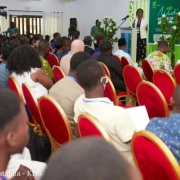
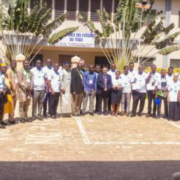
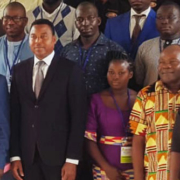
The FOMECAF leadership is pleased to inform Christian media professionals in French-speaking Africa of a regional seminar titled “OUAGA 2023,” to be held from October 30 to November 3, 2023, in Ouagadougou, Burkina Faso.
With the aim of increasingly aligning its activities with those of its partner countries and more effectively supporting efforts at the national level, the Forum is organizing a decentralized meeting this year—in collaboration with Radio Réveil—in the capital of Burkina Faso, one of the current hotspots of conflict in the subregion.
Under the theme “Media: Tools for Peace in a World in Conflict – OUAGA 2023,” this seminar stems from FOMECAF’s strong desire to equip and empower Christian media professionals to play a role in preventing and resolving conflicts on the continent through their action plans.
Participants in OUAGA 2023 will come primarily from countries neighboring Burkina Faso, the host country. These include Benin, Côte d’Ivoire, Mali, Niger, and Togo.
The leaders of the Francophone African Christian Media Forum therefore urge media professionals to continue making use of the tools already made available to them and still accessible through the organization’s official channels:
As for participants from Central and East African countries, they are reminded that seminars are being organized and that very soon, they too will have the opportunity to host the Forum’s sessions.
Confident that your interest in the various initiatives led by FOMECAF remains strong and continues to grow, we wish each and every one of you all the best for the future.
See you soon for a reunion that’s as uplifting and inspiring as ever!
More than 70 representatives of Christian media outlets from French-speaking Africa will gather at the OCDI in Lomé from February 20 to 24, 2023, with the goal of building their capacity and exchanging ideas as part of the Forum of Christian Media in French-Speaking Africa (FOMECAF). Illia Djadi, a journalist and human rights advocate, will be the keynote speaker at this fifth edition, which is themed “Media: Tools for Peace in a World in Conflict.” Held under the patronage of the Ministry of Communication and Media, the minister, Professor Akodah Ayewouadan, will be the guest of honor at the opening ceremony.
FOMECAF is meeting for the fifth time in the Togolese capital. More than 70 participants from nearly 15 countries are expected to attend this major gathering of Christian media from Francophone Africa. Furthermore, after two previous editions held despite the COVID-19 pandemic, this edition marks the return of four hands-on workshops led by distinguished international guests: Joël Pelet, Director of “Canal Alpha” television in Switzerland; Christian Gaspoz, Director of “Radios Ébène Développement” in Paris; Denis Steffen, a radio consultant and member of the board of directors of Radio Réveil; and Pierre-Yves Mutrux, a program officer with the international organization “Galcom” in Canada. The Swiss association Radio Réveil is co-organizing the event for the last time and is represented by its president, Emmanuel Ziehli. This edition marks the end of a transition process, with the future now lying exclusively in the hands of African leaders.
Illia DJADI, keynote speaker for this year's event
In a world shaken by repeated conflicts that disrupt the economy and daily life in nations, Illia DJADI, drawing on his experience as an analyst, will provide his peers with insights into the issue of conflict on the continent and the tools needed to intervene in the pursuit of peace. He will find the right words to help the journalists attending this meeting understand how to serve as “Tools of Peace” when peace is threatened in the areas they cover. Throughout his presentation, he will address the challenges posed by conflicts in Africa and around the world; the potential for radio and social media to become weapons of mass destruction; and the role the media can play in conflict prevention…
Named the keynote speaker, Illia DJADI is in charge of issues related to religious freedom and belief in Sub-Saharan Africa on behalf of the international NGO “Open Doors.” Illia is an expert in this field and speaks in the media and at international forums to raise awareness about the rise of religious extremism in Africa and the dangers threatening “social cohesion” on the continent. Originally from Niger, he lives in London, where he has been actively involved in the development of FOMECAF for several years.
Lomé 5: Plenary Sessions and Workshops
Lomé will once again feature a combination of plenary sessions and workshops. The plenary sessions, which will be held every morning, will be deeply inspiring experiences led by experienced speakers who are well-versed in the subject matter. As regular attendees of the seminar and fully committed to fostering media convergence in Africa, the various leaders will take turns over the course of five days to explore topics designed to equip participants to become active agents in easing tensions across the continent. The return of practical workshops in the afternoons will also provide added value for participants. Four workshops are offered to participants, including “Studio Sound” by Pierre-Yves Mutrux, “Filmed Radio” by Joël Pelet, and “FM Transmitter” by Christian GASPOZ.
Internet Broadcasting and Leadership
The plenary sessions and workshops of Lomé 5 will be broadcast in their entirety, both live and on a delayed basis, on FOMECAF’s various channels, particularly Facebook and YouTube.
FOMECAF leaders, for their part, will focus on issues related to the organization’s new direction. These five meetings constitute one of the major activities of Lomé 5 (c).
About FOMECAF
FOMECAF was founded in Lomé in 2019 on the sidelines of media training seminars. It brings together about 50 representatives of faith-based media organizations in French-speaking Africa.
Its leadership team consists of:
1. Dr. Abdoualye Sangho, Trans World Radio (TWR), Ivory Coast 2. Dr. Etienne Kiemdé, Radio Évangile et Développement, Burkina Faso 3. Illia Djadi, Open Doors London 4. Olivia Beugre, Radio La Voix de l’Espérance, Ivory Coast 5. Juliette Kpessou, Radio Hosanna, Benin 6. Rev. Timothée Amegan, Mediaafrique Media Training, Togo 7. Dr. Alphonse Teyabé, media consultant, Cameroon 8. Benjamin Holl, Radio Vie Nouvelle, Cameroon 9. Dr. Augustin Ahoga, theologian and sociologist, Benin 10. Blaise Gaïtou, National Director of JEM, Niger 11. Koffi Ahonon, National Director of Compassion, Togo 12. Mawuena Abotschi, Permanent Secretary in Lomé, Togo
The names in bold are members of the executive board. Two international figures are joining for one last time this year:
13. Emmanuel Ziehli, President of Radio Réveil, France 14. Henriette Saindon, Secretary of Africa by Radio, South Africa
https://mediasebene.org/wp-content/uploads/2023/02/Image1.png327714Patriziahttps://mediasebene.org/wp-content/uploads/2024/11/logo-medias-ebene-web-202411-300x138.pngPatriziaFebruary 17, 2023, 2:11:00 PMJune 16, 2024, 1:53:37 PMLOME 5: THE MEDIA AS TOOLS FOR PEACE IN A WORLD AT WAR
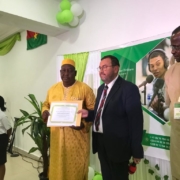
“I dedicate this award to all those who have lost their lives because of their faith!” Abdoulaye Cissé is the director of Radio Tahanint in Timbuktu, Mali. A pastor and businessman at heart, he received the François Sergy Award on Friday, November 26, in Lomé, Togo, during the closing ceremony of the fourth training week for Christian media professionals in French-speaking Africa. Visibly moved, the 55-year-old man, dressed in a traditional yellow boubou, added that he was also dedicating this award to his mentor, Abdoulaye Sangho, Trans World Radio’s International Director for West and Central Africa, one of the main speakers at Lomé 4, who was present that day.
https://mediasebene.org/wp-content/uploads/2021/11/Prix_Francois_Sergy_1.jpeg7681024Patriziahttps://mediasebene.org/wp-content/uploads/2024/11/logo-medias-ebene-web-202411-300x138.pngPatrizia2021-11-27 13:53:302024-06-22 08:12:26Le Prix François Sergy va cette année à Abdoulaye Cissé, directeur de radio à Tombouctou
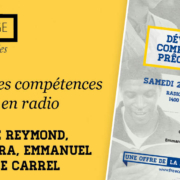
Radio R and FREE COLLEGE are offering a training day on Saturday, August 21, focused on radio preaching, led by radio professionals. Since the start of the partial lockdown in Switzerland in March 2020, Radio R, which broadcasts on DAB+, has opened its airwaves on Sundays to preachers, pastors, and church members so they can deliver sermons. This initiative has continued ever since and has found its audience.
Thinking About a Radio Communication Style
To explore how to speak on the radio and to help guests improve their performances, Radio R and FREE COLLEGE are offering a one-day training session to develop a communication style suited to radio, enhance the quality of guests’ delivery, and provide a supportive space for participants to listen to their own and others’ performances in order to refine their skills.
A day hosted by radio professionals
This event, which will feature radio professionals such as Christine Reymond, Daniele Zagara, and Serge Carrel, is open to anyone interested in preaching on Radio R or who would simply like to improve their preaching skills. (c)
“Developing Your Skills for Radio Preaching,” a one-day workshop co-organized by Radio R in Yverdon-les-Bains and the FREE COLLEGE on Saturday, August 21, 2021, from 9:00 a.m. to 5:00 p.m. Location: Radio R, Galilée 15, Y-Parc, 1400 Yverdon-les-Bains. Cost: voluntary donation. Registration required: freecollege@lafree.ch or online at lafree.ch/free-college/journees
https://mediasebene.org/wp-content/uploads/2021/05/Radio_Developper_competences_precher_en_radio.jpg5651271Patriziahttps://mediasebene.org/wp-content/uploads/2024/11/logo-medias-ebene-web-202411-300x138.pngPatriziaMay 5, 2021, 3:30:22 PMMay 5, 2021, 9:05:20 PMFREE COLLEGE and Radio R on August 21: “Developing Your Skills for Preaching on the Radio”
During the Training Seminar for Christian Radio Stations in French-speaking Africa, the organizers decided to award Dodji Juliette Kpessou, a journalist and host at Radio Hosanna in Porto-Novo, the François Sergy Encouragement Award for producing 50 audio segments titled “L’O2Vie, a Drop Every Day.”
“These programs by Dodji Juliette Kpessou exemplify what we hope to promote: the exchange of programs among Christian radio stations in French-speaking Africa,” explained Emmanuel Ziehli, director of Radio Réveil.
The François Sergy Encouragement Award was launched as part of the Lomé Weeks, an initiative aimed at training Christian media professionals in French-speaking Africa. It is designed to recognize initiatives that promote collaboration among radio stations. This encouragement award is named after François Sergy, a journalist with Radio Réveil who passed away in 2018.
In Lomé, the seminar made headlines in several media outlets, with representatives of the relevant Togolese authorities praising the initiative behind this training program.
For a week, Emmanuel Ziehli, director of Radio Réveil; Serge Carrel, journalist and trainer; Andrea Luzi, technician; Christian Gaspoz of Radio Ébène et Développement; and Professor Alphonse Teyabe shared their knowledge with a discerning and passionate audience. Each day, workshops focused on the practical aspects of radio and the journalism profession alternated with plenary sessions that sparked debate on issues such as the contribution of evangelical radio stations to mission work and journalistic ethics.
Organized to mark the 70th anniversary of the Radio Réveil association, the event was put together in partnership with the International Christian Center for Study, Research, and Information (CICERI) in Lomé and the Radio Ébène et Développement association in France.
https://mediasebene.org/wp-content/uploads/2019/02/tv-togolaise-1.jpg334835Patriziahttps://mediasebene.org/wp-content/uploads/2024/11/logo-medias-ebene-web-202411-300x138.pngPatriziaFebruary 19, 2019, 2:28:45 PMFebruary 19, 2019, 2:47:55 PMTogolese authorities welcome the radio training initiative
https://mediasebene.org/wp-content/uploads/2019/02/IMA-ACTU-alphonse-teyabe.jpg334835Patriziahttps://mediasebene.org/wp-content/uploads/2024/11/logo-medias-ebene-web-202411-300x138.pngPatrizia2019-01-28 13:36:552024-12-27 13:13:38Pour Alphonse Teyabe, «30 pour cent de Jésus» sur les radios évangéliques d’Afrique francophone cela suffit !
A project in Togo to train journalists from evangelical radio stations in French-speaking Africa, combined with the 20th anniversary of the program *Hautes Fréquences* on RTS La Première, provides Serge Carrel with an opportunity to demonstrate that, in both contexts, evangelical journalism requires boldness and professionalism.
Reprint of Serge Carrel's "Opinion" piece published on January 25, 2019, onlafree.info
In our daily lives, there are moments when our experiences collide, prompting us to reflect on our work. Last week, I was one of the facilitators at the Training Seminar for Evangelical Radio Stations in French-speaking Africa, held in Lomé, Togo—a gathering of more than a hundred people organized by Radio Réveil in Bevaix (NE). It was an opportunity to meet journalists, hosts, and technicians from the roughly 100 radio stations that identify as evangelical in French-speaking Africa. Last Sunday evening at 7 p.m., RTS Religion marked the 20th anniversary of *Hautes Fréquences*—the flagship program of the public radio station’s religious programming team—on the airwaves of *La Première*.
In French-speaking Africa as well as in Switzerland, what is the level of presence?
In both situations, this provides an opportunity to reflect on the presence of evangelical journalists in the public sphere. In French-speaking Africa, evangelical religious radio stations are on the rise. Their programming places a strong emphasis on preaching the Gospel, reports on churches, and Christian music. They play an important role not only within the church or churches but also in the public sphere, encouraging the emergence of a shared identity and collective reflection on the major issues of the day. In French-speaking Switzerland, due to the ecumenical and interfaith commitment of the religious programming team and the erosion of the Christian voice’s legitimacy within society, RTS Religion’s approach leans more toward the sociology of religion than toward a Christian perspective on society. This is evidenced by the appearance on Sunday evening of a sociologist, Philippe Gonzalez—a specialist in media and religion—rather than a Christian theologian particularly well-versed in how to position the Christian faith within a pluralistic context.
Professionalism and boldness are more important than ever
In this clash of diametrically opposed experiences lies a convergence. On one hand, African evangelical radio stations are seeking to develop a public discourse that allows them to move beyond an “all-church” focus and reach as many listeners as possible—notably by limiting “Jesus” to 30 percent of programming and giving significant space to development issues and a holistic and integral Gospel (see the Lomé Declaration and the interview with Alphonse Teyabe). On the Swiss side, churches promote—since journalists are employed by the churches and production costs are covered by RTS—a discourse that analyzes religious phenomena from Christian perspectives and values, a discourse legitimized by the history of French-speaking Switzerland and by a society that seeks to understand religion without aligning itself with any particular denomination.
In these two very different contexts, evangelical journalism has its place. In French-speaking Africa as well as in Switzerland, it requires professionalism and boldness. It involves stepping outside the well-trodden paths of vague and unarticulated convictions to seek out and express a perspective on the world shaped by the values and hope that Christ brings to life in the heart of our lives. In both cases: a real “challenge,” as we say today!
Serge Carrel
Senior journalist at lafree.info
Former journalist at Radio Réveil and on the RTS Religion program *Hautes Fréquences*
https://mediasebene.org/wp-content/uploads/2019/02/IMA-ACTU-serge-carrel-free.jpg334835Patriziahttps://mediasebene.org/wp-content/uploads/2024/11/logo-medias-ebene-web-202411-300x138.pngPatriziaJanuary 28, 2019, 1:10:34 PMFebruary 19, 2019, 3:12:11 PMWhat Role Does Evangelical Journalism Play in the Public Sphere?
From January 14 to 18, more than 100 people involved in evangelical radio stations in French-speaking Africa attended a training seminar in Lomé. During the event, participants signed a declaration aimed at promoting relations among evangelical radio stations. This includes the immediate creation of a Facebook page and discussions regarding the establishment of an evangelical news agency and a Federation of Evangelical Media in French-speaking Africa.
Reprint of the article by Serge Carrel published on January 21, 2019, on lafree.info
On Friday, January 18, in Lomé, journalists, hosts, producers, and technicians from more than thirty evangelical radio stations in French-speaking Africa signed a document titled “The Lomé Declaration.”
A Facebook group to encourage collaboration
This document establishes an online group to encourage personal and professional exchanges among participants in the Training Seminar for Evangelical Radio Stations in French-speaking Africa, which was held January 14–18 in Lomé at the initiative of Radio Réveil (Switzerland). This declaration also raises the possibility of creating, in the future, a website for sharing radio content and an African, evangelical, and French-speaking news agency. Finally, the Lomé Declaration proposes the creation of a Federation of Evangelical Media in French-speaking Africa.
For Alphonse Teyabe of Cameroon, author of a doctoral dissertation on “The Church and the Media: The Contribution of Evangelical Radio Stations to Mission” and a key speaker at the training session, “this statement aims above all to encourage the various radio stations to come together and work as a team. It is imperative that we work together to overcome the various obstacles before us: a lack of professionalism and the difficulty of promoting holistic radio programs or those characterized by integral mission.” The founder of several radio stations in northern Cameroon also welcomed the idea of establishing a federation of evangelical media in French-speaking Africa, a proposal accepted unanimously by the participants.
Encouraging a New Approach Among Radio Stations
“This meeting helped break down competitive barriers among evangelical radio stations,” adds Emmanuel Ziehli, director of Radio Réveil and the driving force behind the gathering. “Another concern of ours is the generational gap—between people born in the ’60s and ’70s and young people who don’t see themselves reflected in older leaders. Our goal is to encourage the emergence of new leaders who can communicate the faith to the younger generation.”
Emmanuel Ziehli is planning to organize a second edition of this seminar. It could take place next January in Lomé. “With the population of French-speaking Africa doubling every 25 years, the time has come to pass the torch,” concludes Emmanuel Ziehli. “It is no longer up to the ‘little Swiss’ or the French to produce programs for Africa, but up to Africans to take on this challenge. Radio Réveil hopes to contribute by promoting training on the ground.”
Radio stations from 9 countries
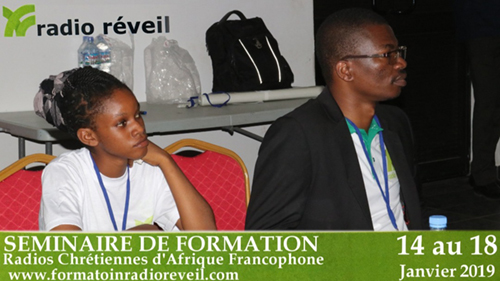
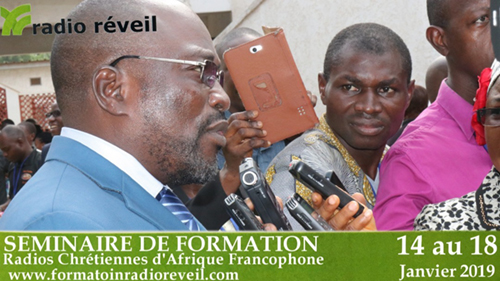
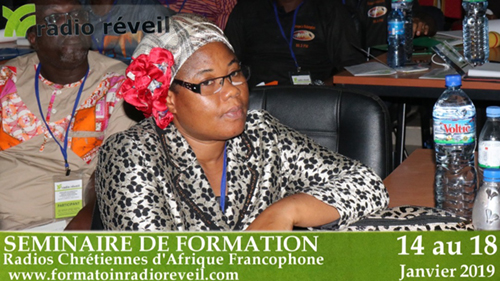
From January 14 to 18, Radio Réveil—a producer of evangelical radio programs for the entire French-speaking world based in Bevaix, Switzerland—organized a training seminar for Christian radio stations in French-speaking Africa in Lomé, Togo, to mark its 70th anniversary. This seminar was organized in partnership with the International Christian Center for Study, Research, and Information (CICERI) in Lomé and Radios Ebène et Développement in France. More than a hundred people actively involved in or interested in radio production—from Cameroon, the Democratic Republic of the Congo, Côte d’Ivoire, Burkina Faso, Mali, Benin, Niger, Senegal, and Togo—participated in the event.
Serge Carrel
Download “The Lomé Declaration,” published on the occasion of the Training Seminar for Christian Radio Stations in French-speaking Africa.
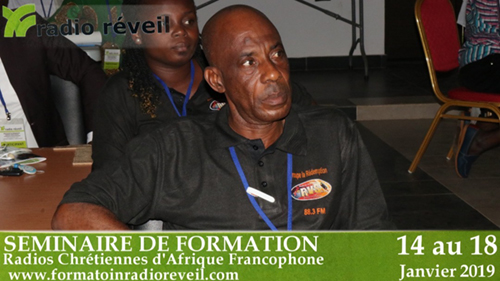
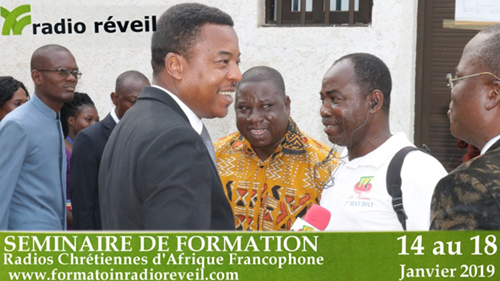
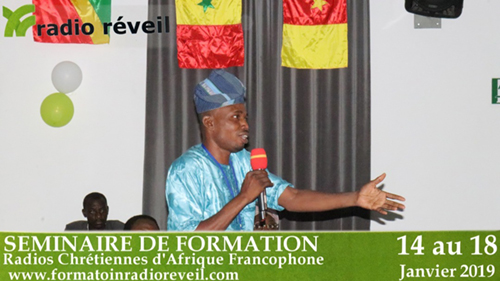
From January 14 to 18, 2019, Radio Réveil is organizing a training seminar for Christian radio stations in French-speaking Africa in Lomé, Togo.
From January 14 to 18, Serge Carrel, Alphonse Teyabé, Andrea Luzi, and Emmanuel Ziehli from Radio Réveil, along with Christian Gaspoz from Radio Ebène et Développement, are sharing their expertise in radio techniques, journalism, and electronic media with about 100 participants from ten West African countries. This is a great opportunity for Radio Réveil to forge new ties with its partner radio stations and to meet new ones.
https://mediasebene.org/wp-content/uploads/2019/02/IMA-ACTU-seminaire-lome-2019.jpg334835Patriziahttps://mediasebene.org/wp-content/uploads/2024/11/logo-medias-ebene-web-202411-300x138.pngPatriziaJanuary 15, 2019, 10:21:39 AMFebruary 19, 2019, 3:13:29 PMMore than 100 participants attended the seminar organized by Radio Réveil in Lomé