
Tag archive for: Shock waves

In the heart of Timbuktu, Radio Tahanint—whose name means “Mercy” or “Pity” in the Tamasheq language—stands as a pioneer and a miracle. Launched in April 2007 by the Evangelical Baptist Church of Timbuktu, it was the very first Christian station to broadcast throughout northern Mali, a region where the media landscape was then dominated exclusively by general-interest or Islamic radio stations.

The history of Tahanint is marked by persecution, particularly in 2012 during the occupation of Timbuktu by Tuareg rebels and their jihadist allies. During this period, the radio station was systematically ransacked, its facilities looted, and its electrical wires torn from the walls to ensure that the Christian voice would no longer be heard. Forced into exile in Bamako, Director Abdoulaye Cissé and his team did not return until 2013, following the recapture of the city. However, the most profound trauma occurred on December 17, 2015, when an assailant emerged from the shadows and opened fire on a group of young people in front of the studios, killing three of them, including one of the station’s hosts. This “darkest day” left an indelible mark on the station’s history, though it did not diminish its resolve.

However, the most traumatic event occurred on December 17, 2015, when an assailant emerged from the shadows and opened fire on a group of young people outside the studios, killing three of them, including one of the station’s hosts
They paid for their commitment to Radio Tahanint with their lives

"Radio Intégrale" as a bridge between communities

To overcome hostility and obstacles, the station adopted a “Radio Intégrale” strategy, positioning itself as a community-based, non-denominational radio station. Rather than limiting itself to purely religious discourse, it broadcasts programs on health, agriculture, and human development to address the human condition in all its dimensions. This approach has yielded unexpected results, as evidenced by the case of a neighbor who is a muezzin and has become a loyal listener to the medical program “Doctor Luc,” which he tunes in to regularly for both his physical and spiritual well-being.

Technological independence and regional influence

Today, Radio Tahanint has turned its weaknesses into strengths thanks to greater technological self-sufficiency and expanded regional reach. In terms of energy, a partnership with FEBA has enabled the station to acquire a large-scale solar power system with lithium batteries, allowing it to broadcast 24 hours a day without relying on an unreliable public grid or being vulnerable to sabotage. Furthermore, its reach is no longer limited to Timbuktu; its programs are now carried by a network of more than 30 partner radio stations throughout the region, notably in Goundam, Diré, and Niafunké, spreading messages of peace where some seek to impose silence. Although threats persist intermittently, Abdoulaye Cissé asserts that the radio station still has a bright future ahead of it, as it has become a key player in Mali’s media landscape.
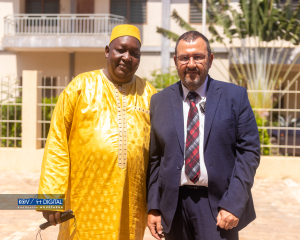
Abdoulaye Cissé was awarded the 2021 "François Sergy" Prize in Lomà, Togo. Here he is with Emmanuel Ziehli.
Abdoulaye Cissé was awarded the 2021 “François Sergy” Prize in Lomé, Togo, pictured here with Emmanuel Ziehli

“Sub-Saharan and Central Africa has become the new global epicenter of jihadism, where groups affiliated with al-Qaeda and the Islamic State are seeking to establish a Sahelian caliphate by encircling urban centers.” In a recent article, Illia Djadi, senior analyst at Open Doors in London, notes that “this security threat is accompanied by deliberate social division, targeting Christian minorities and transforming the region into one of the world’s most acute zones of religious persecution.” Beyond religious issues, and further afield in Central Africa, occupying forces such as the M23 are also terrorizing populations over territorial disputes. In this chaos, radio emerges as a vital medium, a last bastion whose influence is such that it becomes a priority target for those seeking to silence any message of peace. We explore this reality through the accounts of five witnesses in Côte d’Ivoire, Burkina Faso, Mali, and the Democratic Republic of the Congo (DRC).

Ivory Coast 2002: Jean Seri, a Pioneer of Radio Resilience

On September 19, 2002, at 3 a.m., Abidjan was plunged into violence following an attempted coup. In today’s African context, marked by security crises and the rise of radicalism, Jean Seri’s experience serves as a harbinger. While major international broadcasters such as RFI, the BBC, and Africa Numéro 1 were silenced, Christian radio remained the sole beacon in the turmoil.

The Courage of Faith at the Heart of the Struggle

Jean Seri, a SIM missionary and now Chairman of the Board of Directors of Fréquence Vie, lived right next to the studios. The studios were located at a strategic crossroads, between the gendarmerie academy and the police academy. Faced with the chaos, he made a historic decision: to open the station at 5 a.m. to invite Ivorians to pray and broadcast music to soothe their hearts. Alone at the microphone as gunfire rang out, he transformed the media outlet into a tool for spiritual resistance and peace.


This bold presence on the airwaves did not go unnoticed by the attacking forces. On the second day, a rebel called the station directly to demand that the broadcasts be stopped: “You must stop calling on people to kneel and pray… These prayers have prevented our mission from succeeding.” Despite the explicit threat that the radio station would be destroyed, Jean Seri responded with disarming calm, inviting his interlocutor to “reconcile with God rather than kill his fellow man.”

A rapidly expanding national heritage

Today, this legacy of resilience has enabled the station to become the national radio station of the Evangelical Protestant Churches of Côte d’Ivoire. A true media institution, it broadcasts nationwide from Abidjan on 89.4 FM. Its signal now reaches five other key cities across the country: Abengourou, Bouaké, Man, and Yamoussoukro. For Jean Seri, Christian radio stations remain essential tools for preventing the rise of radicalism, as they carry a message of love and peace to places where people can no longer go.

to be reconciled with God rather than kill one's fellow man – Jean Seri, pictured here on the right, Abidjan 2026